

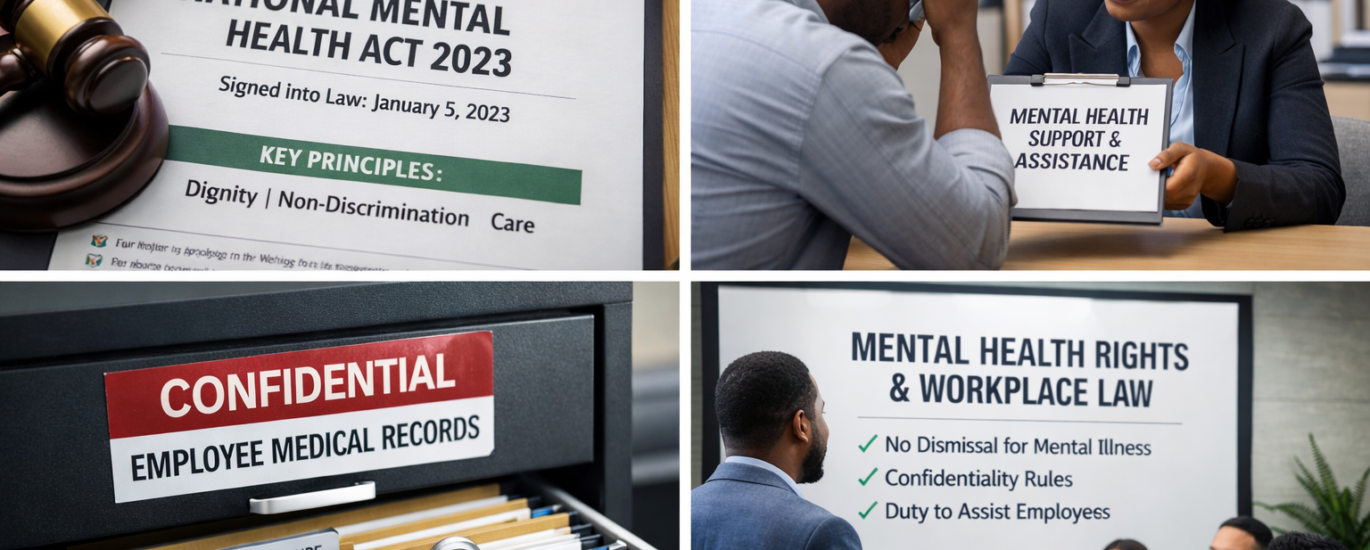
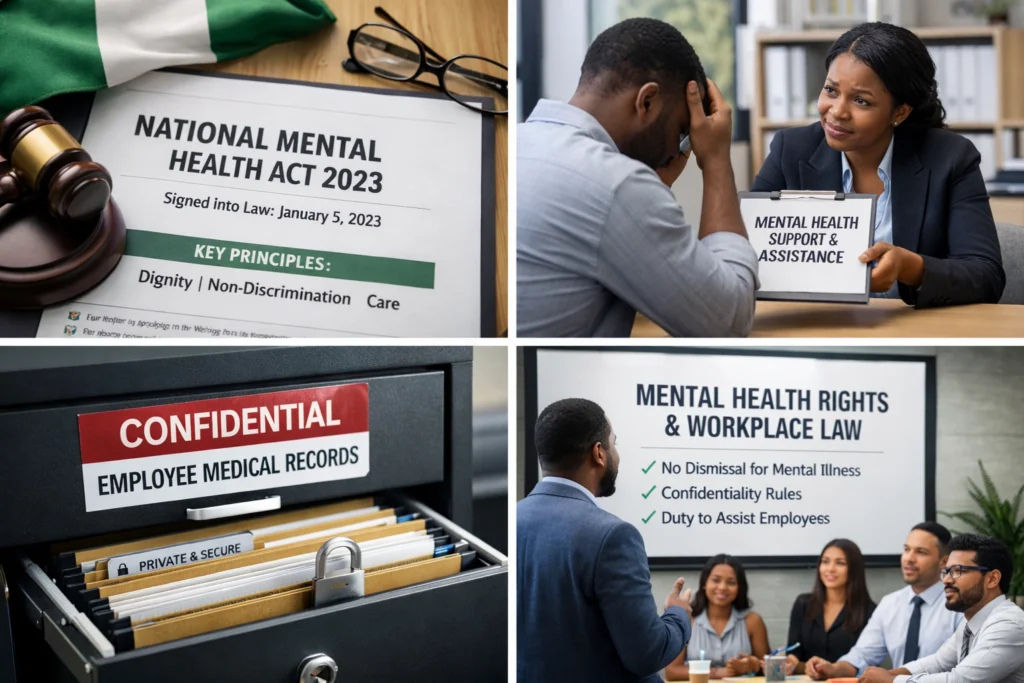
Executive Summary: A Paradigm Shift
For decades, Nigerian mental health law was governed by the Lunacy Act of 1958, a colonial framework that viewed mental illness through the lens of “law and order” and “detention.”
The National Mental Health Act 2023 fundamentally dismantles this outdated structure. It moves away from stigmatizing terms like “lunatic” to “mental ill-health” and establishes strict legal protections for affected individuals. For employers, this is a critical compliance juncture, mental health is now a protected rights category, and mismanagement carries stiff financial and criminal penalties.
1. Employment Security & Non-Discrimination
The most direct impact on mental health in the workplace Nigeria is found in Section 13 of the Act, which protects the employment tenure of individuals.
The “No Dismissal” Rule
- Prohibition: An employer cannot discharge an employee merely on the grounds of mental disorder.
- Treatment Protection: You cannot dismiss an employee simply because they are currently receiving treatment for a mental disorder.
The Duty to Assist
The Act introduces a “support-first” approach. If a mental disorder affects an employee’s workflow or performance:
- The employer is expected to assist the employee in obtaining medical advice or treatment.
- Summary dismissal is no longer the default option for behavioral or performance issues linked to mental health; a pathway to care must be established first.
Note for HR: “Fit to work” assessments must now be handled with extreme caution. Dismissing someone without evidence of attempting to accommodate or assist their treatment could be deemed discriminatory under the Act.
2. Privacy and Confidentiality (Section 21)
The Act enshrines the right to privacy, making the handling of employee medical data a high-stakes responsibility.
- Strict Confidentiality: Medical records and information related to an employee’s mental health are confidential.
- Consent Required: You cannot disclose this information to colleagues, other managers, or third parties without the employee’s free and informed consent.
- Exceptions: Disclosure is only permitted without consent if there is a life-threatening emergency or a specific court order.
3. Corporate Liability & Penalties
The Act is not toothless. It imposes severe penalties for individuals and corporate bodies that violate its provisions.
| Violation | Potential Penalty (Individual) | Potential Penalty (Corporate/Entity) |
| Conspiracy in Unwarranted Involuntary Admission | Fine of ₦200,000+ or min. 5 months prison | Liability extends to the facility/company involved. |
| Continued Involuntary Detention (when not required) | Fine of ₦1,000,000 or 5 years prison | Fine of ₦5,000,000 |
| Use of Restraints/Seclusion (Non-compliant) | Fine of ₦2,000,000 or max 5 years prison | Significant regulatory sanctions |
| Discrimination / Rights Violation | Fine of ₦200,000 – ₦500,000 | Reputational damage and legal liability |
Crucial Warning: The Act specifically notes that for certain offenses, both individuals and facilities (corporates) will be held liable.
4. Handling Crises: Involuntary Admission
Employers often face difficult situations where an employee may be in a severe mental health crisis at work. The Act (Section 28) sets a very high bar for involuntary admission.
You cannot simply “send” an employee to a psychiatric facility against their will.
- Criteria: It must be confirmed that the person has inflicted (or is likely to inflict) harm on themselves or others, and the condition requires admission to prevent deterioration.
- Process: This requires vetting by a medical practitioner and certification by two independent healthcare professionals.
- Risk: Assisting or conspiring to admit someone involuntarily without following this strict due process is a crime punishable by imprisonment.
5. Actionable Steps for HR and Management
To ensure compliance and improve corporate wellness programs in Nigeria, organizations should implement the following audit:
Step 1: Review Your Handbook
Update your Employee Handbook. Explicitly include “Mental Health” in your anti-discrimination and equal opportunity policies.
Old Policy: “Sick leave requires a doctor’s note.”
New Policy: “Sick leave covers both physical and mental health conditions. All medical details submitted will remain strictly confidential.”
Step 2: Audit Your HMO Coverage
Contact your health insurance provider. Ask specifically:
- Does our plan cover psychiatric consultations?
- Is there coverage for psychotherapy sessions?
- Are inpatient mental health services included?
- Action: If the answer is “no,” negotiate an add-on.
Step 3: Train Your Managers
Managers are the first line of defense. They do not need to be therapists, but they must be trained to:
- Recognize signs of burnout and distress.
- Avoid stigmatizing language (e.g., calling an employee “psycho” or “unstable” is now a liability).
- Handle disclosures with empathy and confidentiality.
Step 4: Establish an EAP (Employee Assistance Program)
This is the most proactive step you can take. Contract an EAP provider to offer confidential support services.
- Why: It allows employees to seek help for stress, substance use, or family issues before they impact work performance, without fear of their employer knowing the details.
- How: Engage specialized providers in Nigeria, such as Citron Health, who offer dedicated Employee Assistance Programs. These firms provide third-party counseling and wellness resources that are strictly confidential, ensuring your staff feels safe to access care.
- Communication: actively inform your staff: “You can engage in our Employee Assistance Program provided by companies like Citron Health for free, confidential counseling. No one at the office will know you called.”
Conclusion
The National Mental Health Act 2023 is a “weapon fashioned for the mentally impaired.” It shifts the balance of power significantly. For employers, the key takeaway is empathy over exclusion. Review your liabilities, specifically regarding the handling of medical data and the termination of employment, to ensure you are on the right side of this new legal era.